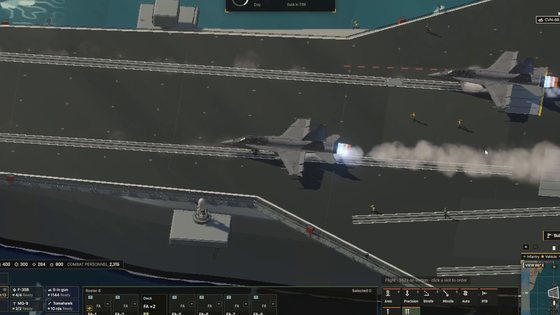
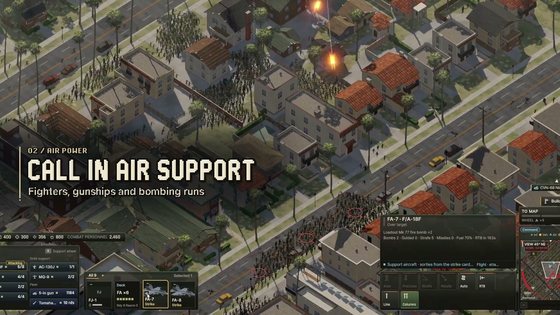
Ebbtide world campaign
The people, troops, equipment and supplies you get to the Port of LA become your starting force aboard the Ark. From there you choose regions to help, bring the carrier group's guns and aircraft into range, resupply at friendly ports, rescue pilots and specialists, recruit allied warships and hunt the Nexus's hidden command nodes.
The world campaign in Ebbtide starts with an evacuation, not a cutscene. Whatever people, troops, equipment and supplies you get to the Port of Los Angeles becomes the starting force aboard TF-1 "Ark" — and from that point the map is the planet, not a city. You pick which regions to help, bring the carrier group's guns and aircraft into range, resupply at friendly ports, rescue the pilots and specialists you cannot train, recruit allied warships, and hunt the Nexus's hidden command nodes.
What you carry out of Los Angeles
The port is the transfer point between acts, which makes the last hours of the LA campaign the most consequential in the game. Two players can finish the same 15-district fight and start the world campaign with wildly different fleets.
What transfers is everything you saved:
- People. Specialists and pilots you extracted are not replaced by training later.
- Troops. Surviving squads become part of the Ark's landing force.
- Equipment. Vehicles and aircraft you kept working are hardware in the next act.
- Supplies. Ammunition and fuel stocks carried aboard are your opening magazine.
The world map and the anchors on it
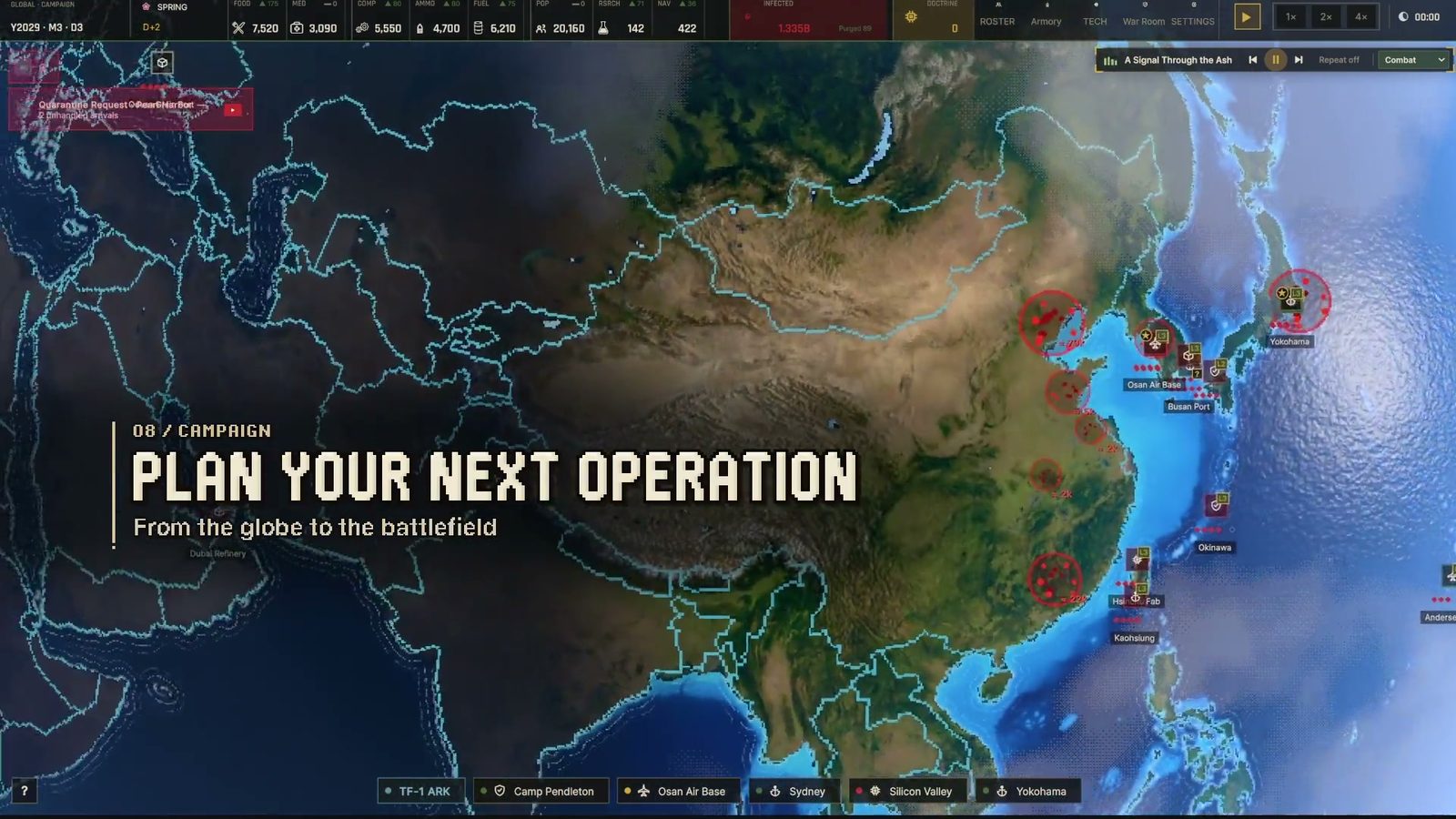
The official footage shows the campaign map with a legend of named locations. These are the places marked on it:
| Location | What it represents on the map |
|---|---|
| TF-1 Ark | The carrier group itself — your mobile base and magazine |
| Camp Pendleton | The Marine source from the Los Angeles act |
| Osan Air Base | A land-based air anchor in East Asia |
| Yokohama | A Japanese port |
| Sydney | An Australian port |
| Silicon Valley | A North American technical/industrial anchor |
Ports matter because of resupply. Air bases matter because they extend the reach of land-based aircraft beyond what the carrier deck can cover. Everything else on the map is either a region you are choosing to help or a node you are choosing to hunt.
Choosing which regions to help
The design is explicit that you choose: not every region gets saved. The decision variables are the ones the LA act taught you, scaled up:
- What can I actually reach? Range is the carrier's constraint. A region the Ark cannot support is a region you cannot hold.
- What does it give me? A port, an airfield, a specialist, a hull. Some regions pay in logistics rather than gratitude.
- What does leaving it cost? A region that falls becomes a Nexus stronghold, and strongholds produce the hordes you will fight later.
Naval power: range is the constraint
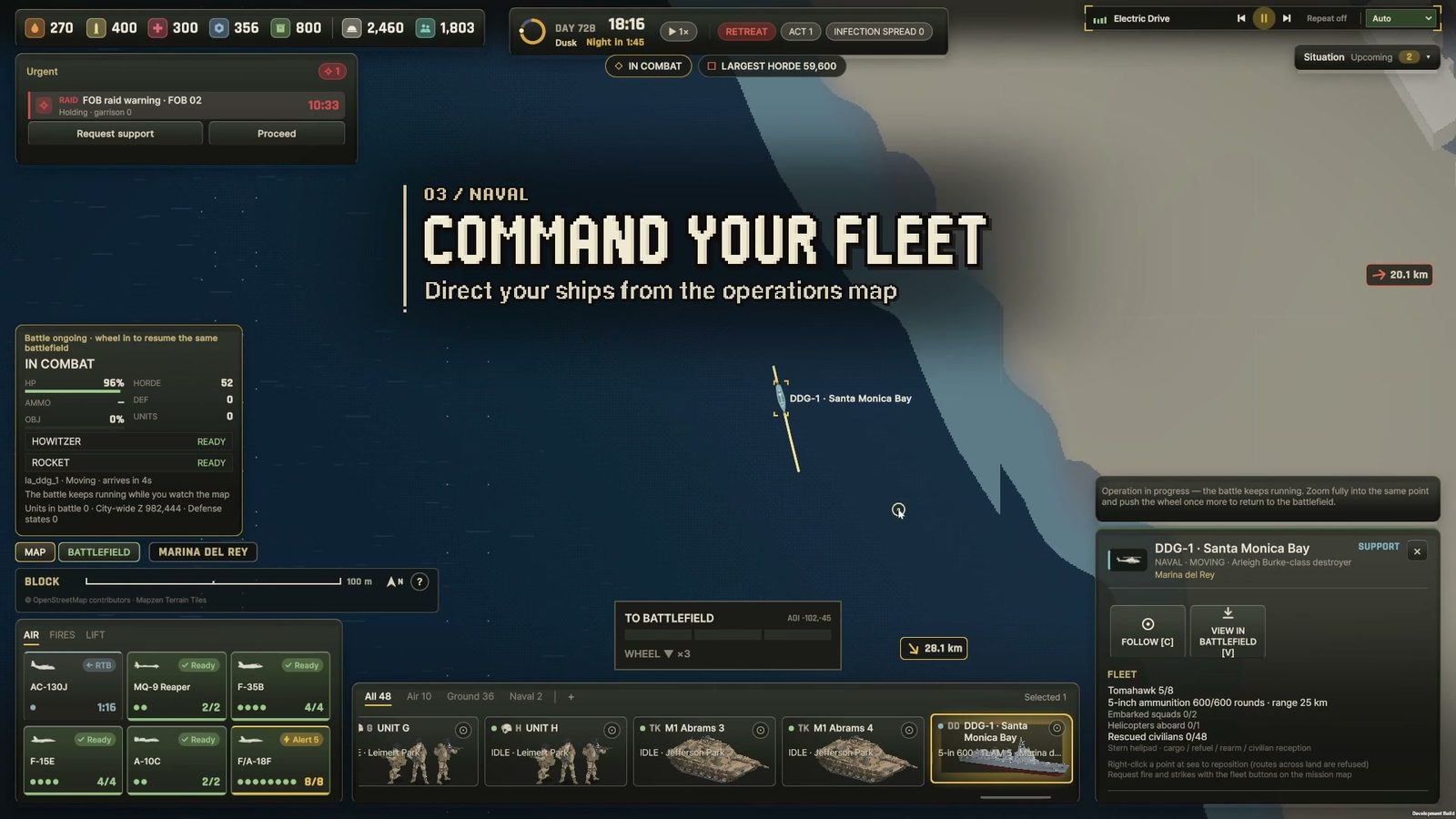
TF-1 Ark is a carrier task force, and the trailer's own chapter card spells out the mechanic: COMMAND YOUR FLEET — Direct your ships from the operations map. Two implications:
- Ships are map units. Destroyer guns and Tomahawk missiles only exist where the hulls are. Moving the group is a decision about which theatres are covered.
- Aircraft follow the deck. Carrier F/A-18s are as mobile as the ship and as limited as its position. Land-based F-15E, F-35B and A-10 sorties come from somewhere else on the map.
Friendly ports and the sea supply chain
Resupply at friendly ports is the naval version of the FOB problem you solved in Los Angeles:
- A port is a rearm point. Ships and aircraft that can dock or land nearby keep working.
- Ports are also targets. The Nexus besieges bases and cuts roads on land; a port is the same vulnerability with a longer approach.
- Distance between ports is the real map. The gap between two friendly harbours is where your fleet is on its own.
If you take one habit from the LA campaign into the world map, make it this: never operate at the end of a supply line you have not secured.
Rescuing people you cannot train
Pilots and specialists are called out specifically as people you cannot simply produce. That makes them the highest-value objective type on the map:
- A pilot is an airframe's worth of capability, since a strike aircraft without a crew is a hangar queen.
- A specialist is a permanent upgrade to something you already do, and there is no equivalent purchase.
- They are time-limited. A rescue is usually a region under pressure; waiting is how the specialist becomes a statistic.
Treat a specialist rescue the way you treated the port in act one: it is worth a disproportionate amount of force, and it is worth abandoning a district for.
Allied warships and the downside of a bigger fleet
Growing the fleet with allied warships is the clearest power curve in the campaign: each hull is another magazine, another covered area, and another thing you cannot afford to lose. That last part is the trade — a bigger fleet means more of the map is your responsibility, which is why the campaign rewards being useful to regions rather than merely surviving them.
The Nexus's command nodes
The hive mind that ran the horde in Los Angeles has hidden command nodes on the world map. Hunting them is the offensive half of the campaign, in contrast to the defensive half of rescuing regions.
Three things make node-hunting different from defence:
- They are hidden. Finding one is an intelligence problem before it is a combat problem.
- They are defended. A node is the thing the Nexus most wants to keep.
- They are the win condition-shaped objective. Every node removed is pressure taken off the rest of the map.
Handover checklist
- Strip the map before you sail. Every specialist and serviceable vehicle that can reach the port should.
- Spend the magazine you cannot take with you. Fire support you leave behind is fire support wasted.