Ebbtide fire support
Fire support in Ebbtide comes from M777 howitzers, HIMARS, destroyer guns, Tomahawk missiles, carrier F/A-18s, F-15E, F-35B and A-10 strikes, AC-130J gunships and MQ-9 drones. Ship magazines are finite and heavy weapons collapse buildings you may still need.
Ebbtide's fire support runs from 155 mm guns parked in a field to a Tomahawk launched from a destroyer offshore, and every one of those options is finite. You can call fire support from the operations map or from the battlefield itself, ship magazines do not refill, and heavy ordnance collapses buildings that your own infantry may be using for cover.
Every call-in the game lists
| System | Type | What it is for |
|---|---|---|
| M777 | 155 mm towed howitzer | Sustained fire on a fixed position; the cheap option you can use repeatedly |
| HIMARS | Rocket artillery | Covering a whole street or approach in one pass |
| Destroyer guns | Naval gunfire | Heavy, accurate, and only available while the hull is in range |
| Tomahawk | Cruise missile | Deleting a specific large thing, including the building around it |
| F/A-18 | Carrier strike fighter | Fast response anywhere the carrier air wing can reach |
| F-15E | Strike fighter | Precision on a point target |
| F-35B | STOVL strike fighter | The same job from a deck that needs less runway |
| A-10 | Attack aircraft | Strafing and cannon runs on a mass of infantry |
| AC-130J | Gunship | Orbiting fire on a target you have already found |
| MQ-9 | Drone | Persistent eyes and a light strike, without risking a crew |
That is nine distinct systems plus the naval battery, and they are not interchangeable. The difference between them is time to effect, area covered, and what they do to the street afterwards.
The magazine problem
Ship magazines are finite. That single sentence changes how you should think about the whole list:
- The expensive options are for problems nothing else solves. A Tomahawk on a horde in an alley is a wasted hull's worth of magazine.
- The cheap options are your working tools. Gunnery and rocket fire are how you break an assault you can see coming.
- Nothing refills from the sea. Resupply belongs to bases you hold, which is why a fire-support habit without a supply plan ends a campaign.
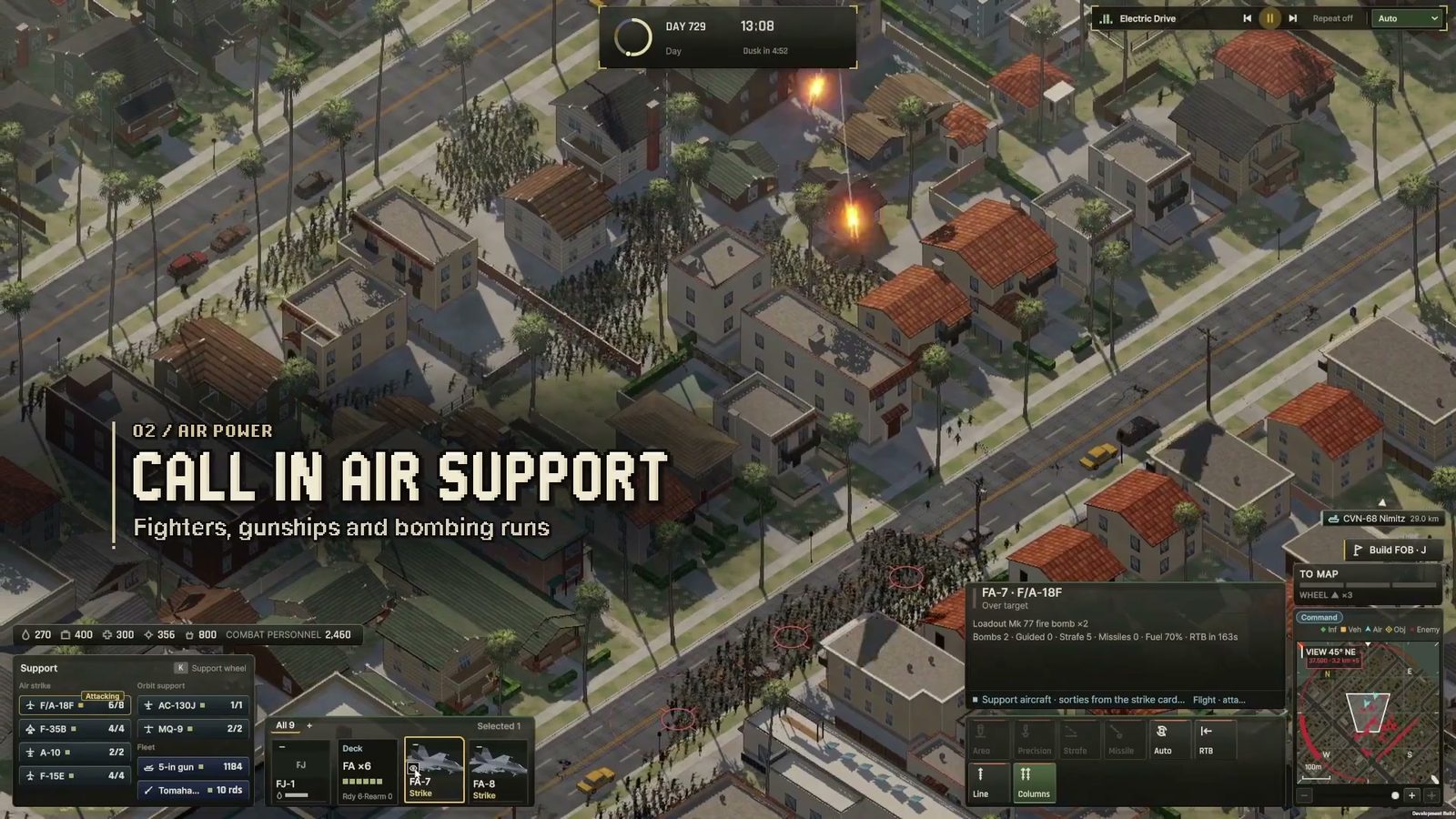
The HUD makes this visible rather than hidden: a support roster in the corner of the screen lists airframes with an availability fraction (the official footage shows entries in the shape of F/A-18F 6/8, A-10 4/4, MQ-9 2/2) and readiness words like HOWITZER READY and ROCKET READY. Treat that roster as your real ammunition state, not the number of enemies on screen.
Buildings are cover, and cover is a resource
Heavy weapons bring buildings down. That is a mechanic, not a side effect. Every structure on a Ebbtide street is potentially:
- Cover for your infantry,
- A firing position for a squad on a rooftop,
- An obstacle that channels a horde into a kill zone,
- A climbable surface the horde uses to get above your walls.
So the question before any heavy mission is not "how many zombies will this kill", it is "what will this street look like afterwards, and do I still want to fight in it?" Flattening a block to stop an assault is a legitimate answer. Flattening the block your evacuation route runs through is how a won battle becomes a lost district.
Air: matching the airframe to the target
A working division of labour:
- Massed infantry in the open — A-10 cannon runs and gunship orbits. This is what those airframes exist for.
- A single hard target — F-15E or F-35B precision, or a Tomahawk if it is genuinely worth a missile.
- A street that needs to stop existing — HIMARS or naval guns.
- A target you have not found yet — MQ-9. Drone time is how you turn a dark district into a known one.
- Something that must die in the next sixty seconds — whatever is already on station.
The carrier is the reason the fast options exist at all: F/A-18s come off the deck of TF-1 Ark, which means their availability follows the ship, not a global cooldown.
Calling it from the map versus the battlefield
Both work, and they are used for different reasons:
- From the map you are spending fire support as a strategic decision — stop an approach before it reaches a district, break up a convoy ambush you were warned about, buy time on a front you cannot reinforce.
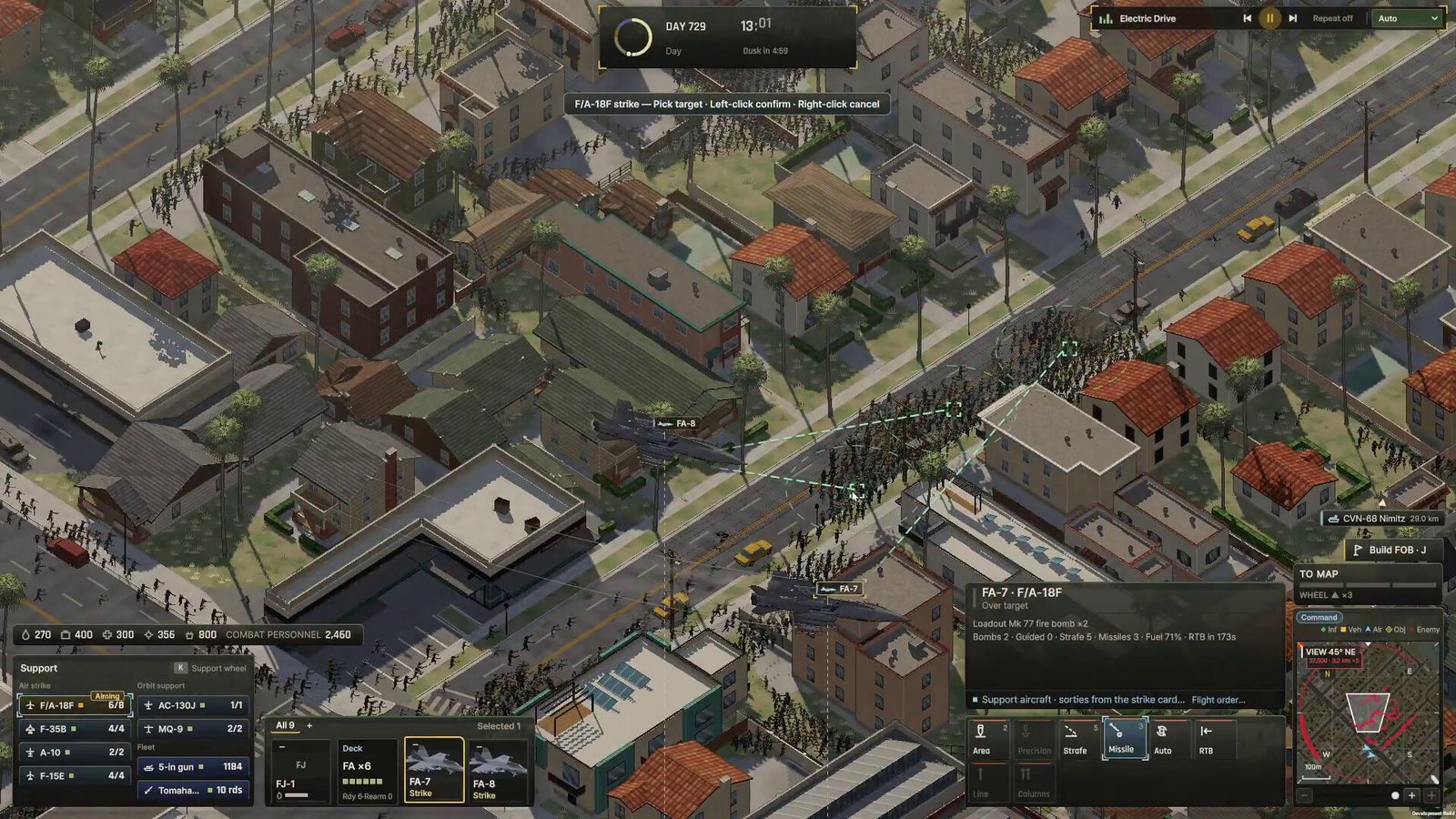
- From the battlefield you are solving a tactical problem you can see — a wall of zombies on a street you are personally standing in, a building that has become a nest.
The map is where fire support is most efficient, because you are reacting to the warning the game gives you before an attack lands. The battlefield is where it is most urgent.
Three rules that keep the magazine alive
- Never spend the last of a system on something infantry could do. Fire support exists to solve problems units cannot reach in time.
- Keep one heavy option in reserve for the district you actually care about. The temptation is to use it on the first Crisis you see.
- Check what the strike does to the ground you are standing on. Your own units are on that street, and the buildings are the reason they are still alive.
The Nexus, meanwhile, is doing the same arithmetic from the other side: it ambushes convoys, cuts roads and besieges bases, which is exactly the set of targets fire support is best at answering — if you have anything left in the magazine when the warning arrives.